Information
These questions reflect how serious leaders evaluate strategy.
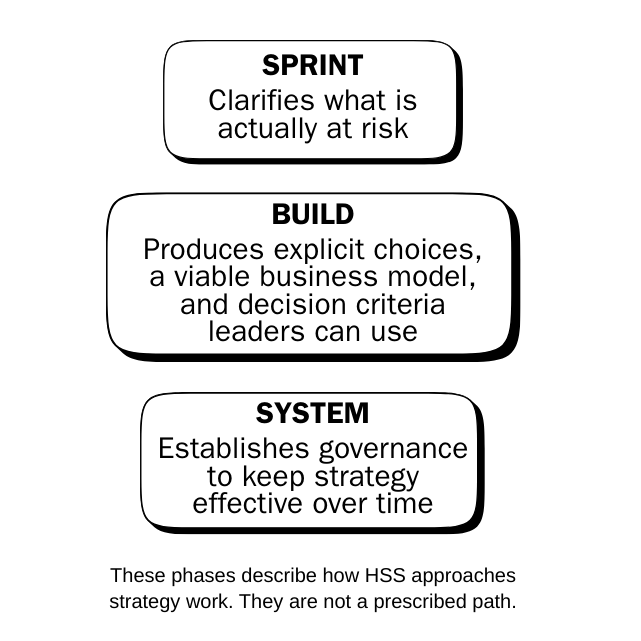
Haas Strategy Solutions works in three phases.
- Sprint clarifies what is actually at risk.
- Build produces a strategy grounded in explicit choices, a viable business model, and decision criteria your leadership team can actually use.
- System establishes the governance needed to keep strategy effective over time.
The questions below are typically asked once leaders realize that planning alone is no longer sufficient.
Why do capable leadership teams still struggle with strategy?
Because most strategies are never fully formed. Planning organizes goals and initiatives, but it rarely forces explicit choices, tests assumptions, or resolves tradeoffs. The resulting strategy may look complete, yet remain fragile under pressure.
How do we know whether our strategy is actually sound?
A sound strategy makes clear choices. It explains where you will compete, how you expect to win, what you will not do, and the conditions under which those choices would change. If those answers depend more on process or alignment than on explicit decisions, the strategy is likely fragile.
What is usually missing when strategies fail in practice?
Most strategies fail where choices meet reality. Assumptions remain implicit, tradeoffs are postponed, and decisions depend on personalities rather than shared criteria. Execution eventually exposes these gaps, at which point correction is slower, costlier, and harder to reverse.
What problem does Haas Strategy Solutions solve, specifically?
HSS exists to close that gap. We help leaders turn intent into explicit choices, a coherent business model, and decision criteria that hold up when decisions must be made under pressure.
Who is this work for, and who should not engage?
This work is for CEOs and boards willing to test assumptions, confront tradeoffs, and make decisions that will disappoint someone. It is not for teams seeking validation, consensus-building, or cosmetic alignment.
Why does HSS use Sprint, Build, and System?
Because strategy failure happens at different stages.
- Sprint clarifies what is actually at risk.
- Build forms the strategy through explicit choices and business model logic.
- System establishes governance so strategy remains effective over time.
What is the Strategy Sprint?
Sprint is a short, focused diagnostic that surfaces where strategy logic is thin, contradictory, or untested. It answers one question: Is deeper work necessary?
When does Sprint make sense, and when does it not?
Sprint makes sense when leaders need clarity on whether a real strategy problem exists. If you already suspect gaps, contradictions, or fragile assumptions, Sprint will only confirm what you know. Build is the faster path to resolution.
What is Strategy Build?
Strategy Build is the phase where strategy is actually formed.
It converts intent into explicit choices, a viable business model, and decision criteria leaders rely on when the stakes are real. Build ends when strategy moves from aspiration to usable judgment.
Most organizations think they have a strategy until Build proves otherwise.
How is Build different from strategic planning?
Strategic planning organizes goals and initiatives. Build forces tradeoffs, tests assumptions, and resolves contradictions before execution begins. Planning aligns people. Build clarifies what the organization will and will not do.
What usually prevents a strategy from holding up in practice?
Most strategies fail where choices meet reality. Assumptions remain implicit, tradeoffs are postponed, and decisions depend on personalities rather than shared criteria. Over time, execution exposes these gaps. By then, correction is slower, costlier, and harder to reverse.
What exactly gets built?
Build produces clear strategy logic, a coherent business model, explicit assumptions, and decision criteria. Anything that does not improve judgment is removed. The result is not a document, but a strategy leaders can explain, defend, and execute.
Why does Build take about 90 days?
Because serious strategy requires time to surface contradictions, test logic, and resolve disagreements before they become execution failures.
What role does the CEO play in Build?
A direct one. Strategy cannot be delegated. If the CEO is not personally involved, Build should not begin.
What happens if the executive team disagrees?
That disagreement already exists. Build makes it visible and productive instead of letting it leak out later as slow decisions and friction.
Will Build tell us if our current strategy is weak?
Yes. Avoiding that answer is usually more dangerous than hearing it.
What is Strategy System?
System is the governance layer that keeps strategy alive over time. It tracks assumptions, monitors signals, and supports ongoing decision quality.
When does System make sense?
Only after Build. System without Build institutionalizes weak logic and creates false confidence.
How does this work handle uncertainty like AI or regulation?
By explicitly modeling assumptions and testing whether your strategy can still make choices as conditions change.
What deliverables come out of this work?
Each phase produces different outputs, tied to the decisions it is meant to support.
- Sprint produces a clear diagnosis, priority risks, and a decision on whether deeper work is warranted.
- Build produces explicit strategy logic, a tested business model, assumption registers, and decision criteria.
- System produces governance rhythms, monitoring signals, and decision rules to keep strategy alive over time.
Anything that does not improve judgment is removed.
How is this work priced?
Fixed fee, based on complexity and risk, not organization size. Strategy risk does not scale cleanly with revenue.
What is the first step?
A direct conversation to determine whether Build is the right move now, or whether Sprint or restraint is wiser.